
The install itself takes a day. The full journey takes 2–4 weeks. That split is the thing most people are not told when they ask "how long does solar take?" The roof work is the short part. Western Power, the meter and a roof that is not a simple hip are the part that moves a job from the quick end of the range to the far end.
This is the timeline we quote Perth customers. It matches the inclusions on the current packages: grid application, meter changeover, monitoring, and a 15-year workmanship warranty. Installation on those packages is 80% in-house and 20% subcontractors.
Week 0: quote and design
The quote form is the start, not a site meeting. We design from satellite imagery and a phone consult, then confirm with photos. A complex roof, heavy shade, a tile roof with limited access, or a switchboard that looks tired gets a site visit before anyone orders hardware. That visit is how a 6.6 kW design stays a one-day install instead of becoming a return trip.
The usual residential starting point on the package list is 6.6 kW: 14 × 475W panels, a 5 kW hybrid-ready inverter, about 30 m² of roof. Homes with a pool, ducted air-conditioning or an EV charger are more often the 10 kW package: 23 × 440W panels, an 8 kW hybrid inverter, about 48 m². Single-phase and three-phase both appear on those listings. Single-phase export limits are handled in the design, not discovered on the morning of the install.
If a battery is part of the same job, say so at this step. A 10 kW system with a battery is a full day on site. Finding out on installation morning that a battery was assumed is how a one-day roof job becomes a reschedule.
Week 1–2: approvals
Two approvals happen before we install:
- Western Power — grid connection approval, typically 5–10 business days.
- Synergy — notification so the meter can be reconfigured.
We lodge and track both. You do not fill in a form for either. What you can do is answer quickly if the distributor asks for a photo of the switchboard or the meter number. Silence at that step sits inside the 2–4 week range; it does not create a new, longer promise, but it is the usual reason a job drifts toward week 4.
From 1 May 2026, new and upgraded systems on the SWIS also have an export-path choice, standard or flexible. That is a design decision we make in the application, not extra homework for the household. Systems already installed before that date are not pulled back through the new rules. The detail is in the May 2026 connection rules.
Installation day
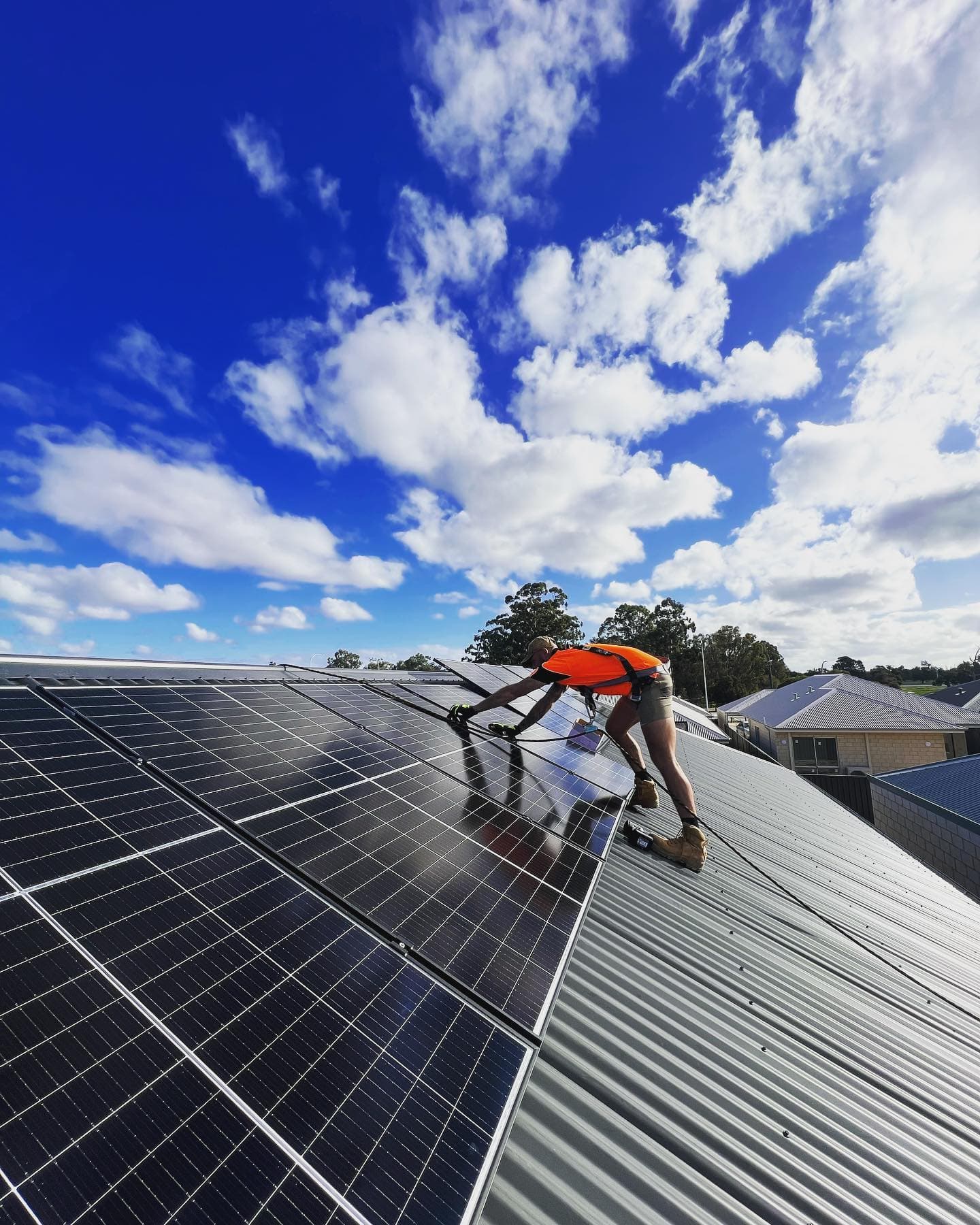
A standard 6.6 kW install takes our in-house crew 4–6 hours. A 10 kW system with a battery is usually a full day. The sequence is the same either way:
- Access, a walk-through of where the inverter and any battery will go, and isolation of the supply.
- Mounting rails and panels, then the DC cabling back to the inverter location.
- Inverter, and the battery if there is one, on the wall. Hybrid inverters on the 6.6 kW and 10 kW packages are battery-ready even when the battery is not installed today.
- Switchboard connection, labelling, and testing.
- Monitoring on your phone, and a handover of what the app is showing.
The system is tested and, where the meter allows, switched on the same day. You need to be there at the start for access and at the end for that handover. The middle of the day does not require you in the roof space.
What pushes a "4–6 hour" job toward a full day, still inside the timeline we already quote: a steep or fragile roof, a split array on more than one face, a switchboard that needs work before it can take the inverter, or limited access down the side of the house. We would rather see those at the quote than at 7am with the rails on the driveway.
After switch-on
Synergy reconfigures the meter, sometimes 1–2 weeks later. Your system still runs during that window and still offsets what the house uses. You are not waiting in the dark for a meter technician before the panels do anything.
The 15-year workmanship warranty starts at handover. Balance-of-system cover on the business warranty is 10 years, separate from the panel and inverter manufacturer warranties. Monitoring is part of the package inclusions, not an optional extra you set up yourself the following weekend.
Bills change on the next cycle, not the afternoon of the install. Export credits depend on DEBS (about 10c/kWh from 3pm to 9pm and about 2c/kWh at other times) and on how much you use yourself. The rates guide is the right place for that maths; the install day is the wrong place to expect a new bill.
Where the work is based
The crew works from 3/90 Discovery Drive, Bibra Lake, and 1/42 Pinnacle Drive, Neerabup. The service area is Perth metro and South West WA, Yanchep to Bunbury. Electrical contractor licence EC010771. Phone (08) 6171 4111 if a booking needs to move. A move is a calendar change inside the same approval process, not a new application, unless the hardware or the export path changes.
A plain calendar
- Day 0: quote, satellite design, phone consult. Site visit only if the roof or board needs it.
- Days 1–10 business days: Western Power approval, typically 5–10 business days, and the Synergy meter notification, overlapping rather than stacked end to end.
- Installation day: 4–6 hours for a standard 6.6 kW system, a full day for 10 kW with a battery.
- The following 1–2 weeks: meter reconfiguration if it did not happen on the day. The system is already producing.
End to end, that is the 2–4 weeks we quote. Faster happens when the distributor is quick and the roof is simple. Four weeks is the honest outer figure when an approval or a switchboard question takes the long path. We do not quote a single "next Tuesday" for every house.
Package sizes and what is included on the day are on solar packages. If the question is really "how long until the bill drops?", read Synergy rates and DEBS as well. Generation starts at switch-on. The bill shows it on the next read.
Published 8 May 2026 · CEC Accredited Installers · Licensed Electrical Contractors (WA)